A decision tree from this table is pictorially shown in Figure 7.
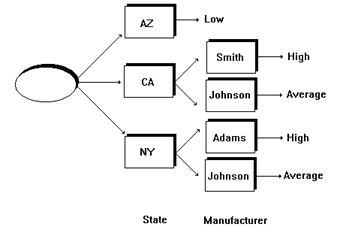
Figure 7.
This decision tree first selected the attribute State to start the partitioning operation, then the attribute Manufacturer. Of course, if there are 100 columns in the table, the question of which attribute to select first becomes crucial. In fact, in many cases, including the table above, there is no best attribute, and whichever attribute the tree chooses there will be information loss, as shown in "Rules Are Much More Than Decision Trees", (Parsaye, 1996). For example the two facts:
(a) "Blue products are high profit."
(b) "Arizona is low profit".
can never be obtained from the table above with a decision tree. We can either get fact (a) or fact (b) from the tree, not both, because a decision tree selects one specific attribute for partitioning at each stage. Rules and cross-tabs on the other hand, can discover both of these facts. For a more detailed discussion of these issues, please see "Rules Are Much More Than Decision Trees" (Parsaye, 1996).