|
Belief Networks
Belief networks (sometimes called causal networks) also rely on co-occurence counts, but both the graphic rendering and the probabilistic representation are slightly different from agents.
Belief networks are usually illustrated using a graphical representation of probability distributions (derived from counts). A belief network is thus a directed graph, consisting of nodes (representing variables) and arcs (representing probabilistic dependencies) between the node variables.
An example of a belief network is shown in Figure 9, where just the color attribute has been drawn for the sake of simplicity. This is the same cross-tab as in the previous section.
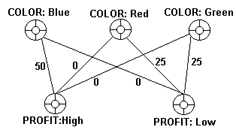
Figure 9.
Each node contains a conditional probability distribution that describes therelationship between the node and the parents of that node. The belief network graph is acyclic, meaning that there are no cycles.
Please compare this to Figure 8, to see that the arcs in this diagram denote the probabilistic dependencies between the nodes, rather than “impacts"computed from the cross-tabs.
Copyright (C) 1997, Journal of Data Warehousing, December 1997 |